
Selling on Social Media: A Simple System That Turns Followers into Buyers
Selling on social media works when every post has a job: attract the right person, earn a small next step, then move them towards an offer that solves a problem they already feel. Most accounts post to be seen and hope buyers appear, so followers grow and sales don’t.
This guide is for business owners and marketers who sell a product or service online, from beginner to expert. It works whether you have ten followers or ten thousand.
This guide is part of the course The Amazing Social Media Sales Machine. If you want the whole system set up step by step, our course on selling on social media walks through every stage, platform by platform.
See the course →Why most social media selling stalls
The usual advice is to post more, stay consistent and add a link in the bio. That gets you reach. It doesn’t get you buyers, for four reasons.
- No clear customer. Posts are written for everyone, so nobody feels they are about them.
- No stages. A sale happens in steps. Asking a stranger to buy in the first post is like proposing on a first date.
- Selling the solution. People buy relief from a problem. A post about your features asks them to do the translation.
- No next step. A good post that ends with nothing to do is entertainment, not selling.
None of this needs more posting. It needs each post to sit at a known point in a simple path.
A simple system for selling on social media
Here is the path we use. You can build it with Claude in a few working sessions, and you only build it once.
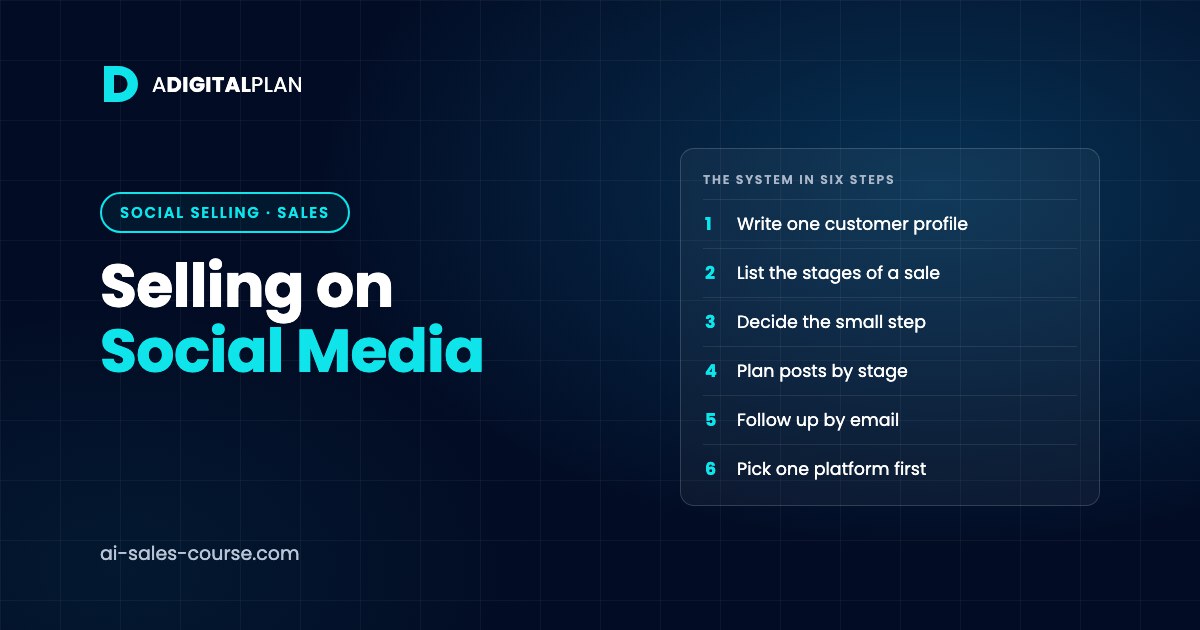
- Write one customer profile. Who they are, the problem they have this week, what they have already tried and what stops them buying. Use real comments, messages and reviews where you have them.
- List the stages of your sale. For most businesses: notice, trust, small step (a free guide, a quiz, a call), offer, buy. A coffee sells in one stage. A high-priced service needs all of them.
- Decide the small step. One free, useful thing that moves a follower off the platform and onto your email list. This is where social stops being rented space.
- Plan posts by stage, not by topic. Problem posts for noticing, method and proof posts for trust, invitation posts for the small step. Most of your posts should be the first two.
- Follow up by email. A short sequence that answers the doubts your profile listed, then makes the offer.
- Pick one platform first. Go where your customer already is. Facebook, Instagram, LinkedIn, YouTube, Reddit and Pinterest each reward a different kind of post.
This is the core of social selling: help in public, invite in private, and let the email do the closing work.
Two prompts will do most of the heavy lifting. Paste the first into Claude with your own details in the square brackets.
I sell [your product or service] to [who buys it].
Here are real comments, messages and reviews from customers: [paste them].
Write a one-page customer profile: the problem they feel this week,
what they have already tried, what stops them buying, and the exact
phrases they use. Quote them. Do not invent anything that is not in what I pasted.
Using the customer profile above, plan 12 social posts for [platform].
Label each one Notice, Trust or Invite. Notice posts describe the problem
in the customer's words. Trust posts show the method or one honest lesson.
Invite posts offer [your free next step]. No more than 2 Invite posts.
Write the opening line of each post.
Worked example (fictional demo)
The business below is a fictional demo, made up to show the method.
Fern Street Pottery sells handmade dinner sets online. Its posts were beautiful product photos with a shop link, and they got likes from other potters. The owner wrote a profile from twenty customer reviews and found the real problem: buyers wanted plates that survive a dishwasher and still look handmade. That phrase, in the customers’ words, became the Notice posts. The Trust posts showed a plate going through a hundred dishwasher cycles on the studio’s own test rack. The small step was a free care guide that asked for an email address. The email sequence answered the two doubts from the reviews, chipping and delivery breakage, and then showed the sets.
If you want to see how this path connects across a whole funnel, read our guide to a social media marketing sales funnel strategy.
Common mistakes
- Writing the customer profile from imagination. If it isn’t from real words, it is a guess with a name.
- Putting a link in every post. People learn to scroll past you.
- Running five platforms badly instead of one well.
- Building the posts but not the email follow-up, so interest has nowhere to go.
- Changing the offer every week, so you never learn which stage is weak.
Build the full system
The Amazing Social Media Sales Machine is our full course on this method. It covers customer avatars, how and why people buy, the stages of a sale, writing an offer, lead generation, landing pages, email and the content you need at each stage. Then it walks through Facebook, YouTube, LinkedIn, Reddit and Pinterest, with separate blueprints for high-ticket, subscription and low-ticket products. You finish with a working social media sales funnel you can copy into your own business and keep improving.
FAQ
How long before selling on social media brings sales?
There is no honest fixed answer. It depends on your offer, your price and how warm your audience is already. What you can control is whether each post has a job and whether interest has somewhere to go.
Do I need a big following?
No. A small following of the right people, moved through clear stages, beats a large one that never takes a next step. Start with the customer profile, not the follower count.
Which platform should I start on?
The one your customer already uses to look for answers. For many business services that is LinkedIn or YouTube. For many consumer products it is Instagram, Facebook or Pinterest. Pick one, build the path, then add a second.
