
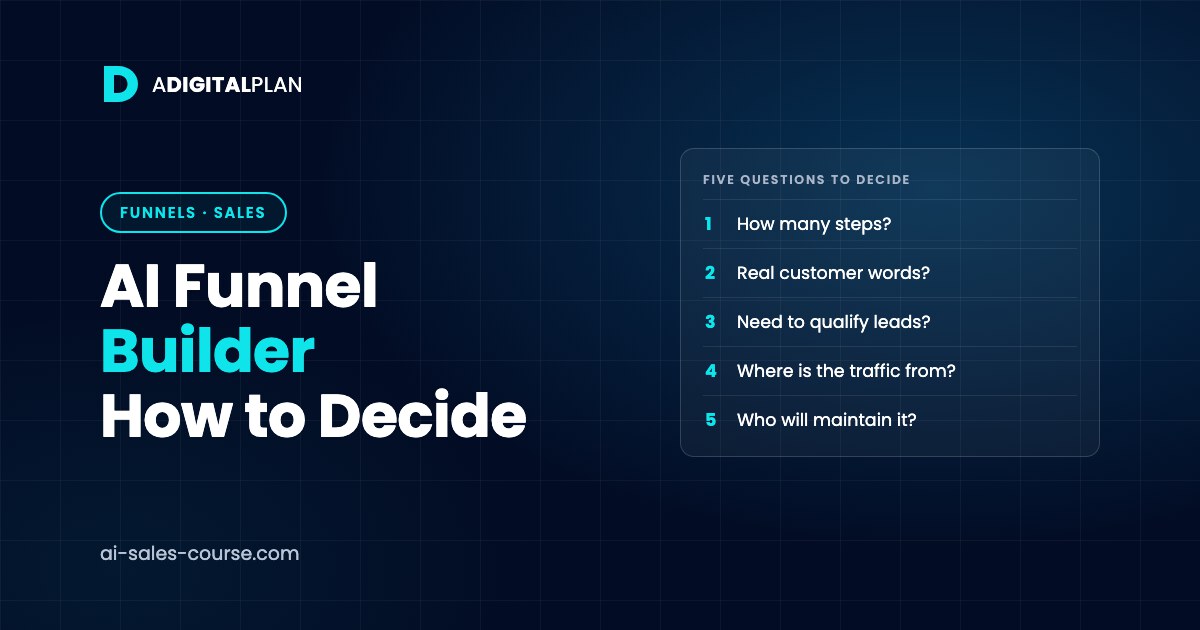
AI Funnel Builder or Build It Yourself with AI? How to Decide
Use an AI funnel builder when you need a standard funnel live quickly and your offer is simple. Build it yourself with AI when your buyers need more than one step to decide, because the thinking behind the funnel matters more than the software that hosts it.
This is for business owners, coaches, consultants and small teams, from beginner to expert. No technical skills are needed for either route.
This guide is part of the course AI Sales Funnels. If you would rather not depend on an AI funnel builder, our course shows you how to set up each stage with AI yourself, from lead capture to follow-up.
See the course →What an AI funnel builder does and doesn’t do
An AI funnel builder is software that generates pages, forms and email steps from a short description of your business. It is good at layout, hosting and connecting a form to an email list. It is weak at the part that decides whether the funnel sells: who it is for, what they believe before they arrive, and what doubt stops them buying.
Ask any tool for “a funnel for my bookkeeping service” and you get a reasonable page written for an average bookkeeper. That is the problem. Your buyers aren’t average, and the funnel can only be as specific as what you feed it.
Why template funnels underperform
- The persona is a guess. The tool imagines your customer instead of using what your customers have actually said.
- One step for every offer. A low-priced product can sell from one page. A high-priced service needs a small step first, such as a guide, a quiz or a short call.
- No qualification. Everyone who fills the form gets the same emails, so serious buyers and casual readers are treated the same.
- Follow-up stops early. Many people decide later, after a second or third useful message.
How to decide: five questions
- How many steps does your buyer need? One step: a builder is fine. More than one: plan the stages yourself first.
- Do you have real customer words? Reviews, emails, call notes. If yes, build your persona from them with AI and give it to whatever tool you use.
- Do you need to qualify leads? If you only want to talk to some of them, you need scoring questions and different follow-up paths.
- Where will the traffic come from? Social, search and email visitors arrive with different levels of trust. Plan the first page for the warmest source.
- Who will maintain it? If nobody will review it monthly, keep it simple.
If you answered “more than one step” or “yes, we qualify”, the build-it-yourself route usually pays off. Here is how to build a sales funnel that way, using Claude for the thinking and any page tool for the hosting.
- Write the persona from real data. Paste in customer words and ask Claude for a profile with their problem, objections and phrases, quoted.
- Map the stages. Notice, first step, nurture, offer, purchase. Write what the buyer needs to believe at each one.
- Design the lead capture. One useful free thing and two or three questions that show how ready someone is.
- Write the nurture emails. One email for each objection in the persona, then the offer.
- Build the pages last. Now the builder has something specific to work with.
- Review monthly. Look at where people stop, and change that one step.
A prompt for step two:
Here is my customer profile: [paste].
I sell [offer] at [price range] to [who].
Map a sales funnel with 4 to 6 stages. For each stage, write:
what the buyer believes when they arrive, what they need to believe
to move on, the one asset that does that job, and the next step.
Flag any stage where you are guessing because the profile is thin.
And one for lead qualification:
Using the profile and funnel above, write 3 short form questions
that show how ready someone is to buy [offer], without feeling like a test.
For each answer, say which follow-up path the lead should go to:
ready now, needs more information, or not a fit.
Worked example (fictional demo)
The business below is a fictional demo, made up to show the method.
Redwood Ledger offers monthly bookkeeping for small builders. A template funnel gave it a page saying “Stress-free bookkeeping” and a contact form. The owner pasted ten client emails into Claude and found the real worry: builders were scared of a tax bill they hadn’t planned for. The new funnel led with a free year-end checklist for builders, asked two questions (how many staff, who does the books now), and sent builders with staff a short case for monthly bookkeeping. The page software didn’t change. The words did.
If your traffic comes mainly from social posts, see how the first stage works in our guide to a social media sales funnel.
Common mistakes
- Letting the tool invent your customer.
- Asking for a sale on the first page for a high-priced offer.
- Sending every lead the same emails.
- Building five funnels before one works.
- Promising results on the page that you can’t show.
Build the funnel yourself, with AI
AI Sales Funnels is our full course on this route. It runs in six parts: how AI fits each funnel stage, the foundation (customer data, personas and your tool stack), lead generation with scoring and chatbots, nurturing with email sequences and retargeting, converting leads into sales, and scaling and ongoing improvement. You finish with the core of an AI marketing funnel: lead capture, qualification, a nurture sequence and follow-up you understand and can change.
FAQ
Is an AI funnel builder enough on its own?
For a simple, low-priced offer it can be. For anything that needs trust first, give it a real persona and a stage map, or build the steps yourself.
Do I need to code?
No. Claude does the planning and writing. A page and email tool you already use can host it.
Which part should I build first?
The persona from real customer words. Every page and email after it depends on that.
