AI Sales Training: What Your Team Actually Needs to Learn
Good AI sales training teaches a team five working habits, not a list of tools: research before every conversation, qualify against written rules, write personal follow-up, keep the pipeline moving, and review what happened. Teach those in that order, with shared prompts and a shared knowledge base, and AI becomes part of how the team sells rather than a toy a few people use.
This is for business owners, sales leads and solo sellers, from beginner to expert. You don’t need a technical background or a big team.
This guide is part of the course AI Sales Engine. Our AI sales training course builds the whole system with you, one part at a time.
See the course →Why most AI sales training doesn’t stick
Most teams get a lunchtime demo, a list of clever prompts and a login. A month later two people use it and the rest have gone back to their old habits. The reasons are predictable.
- No shared knowledge. Every rep starts a fresh chat with no context, so the AI writes for an average company, not yours.
- Tools before process. If nobody has written down who a good prospect is, AI just helps you chase the wrong people faster.
- Volume as the goal. Using AI to send more messages is the easiest win to measure and the quickest way to annoy a market.
- No review. Nobody checks what worked, so the prompts never improve.
What your team actually needs to learn
Think of using AI for sales as a sequence. Each habit depends on the one before it.
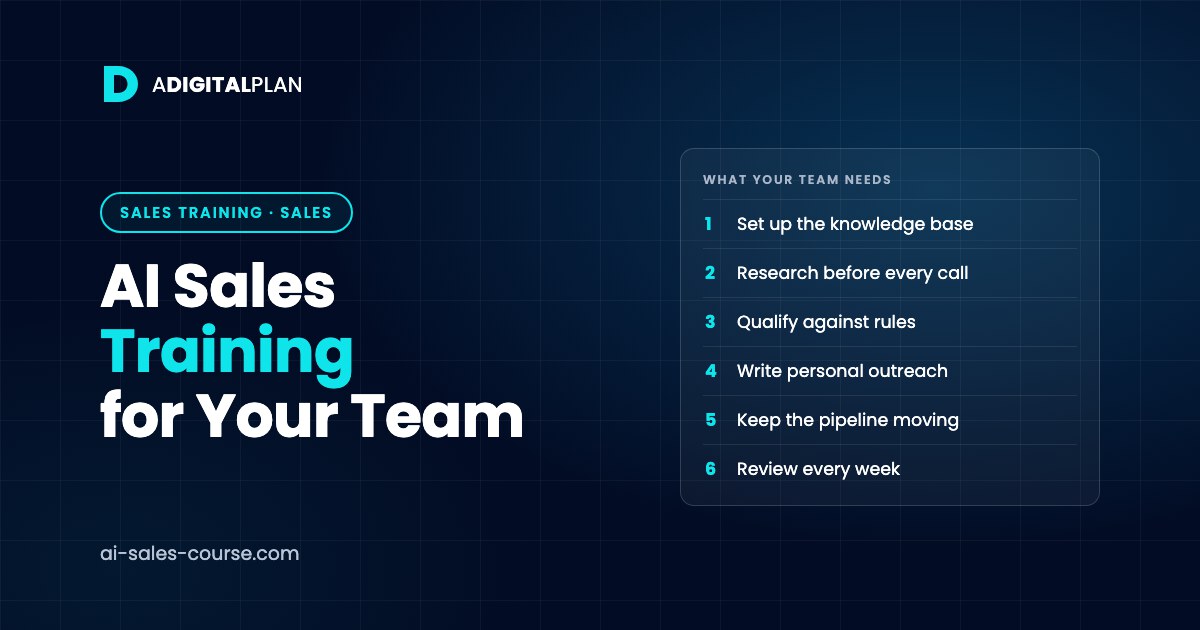
- Set up the knowledge base first. One document that covers what you sell, who buys it, the problems you solve, your proof and the words you never use. Load it into a Claude Project the whole team shares. This single step fixes most generic output.
- Research before every call or message. Teach reps to ask Claude for a short brief from public information and their own notes: what the company does, recent changes, likely problems, and the questions worth asking. The rep checks it. AI prepares; people decide.
- Qualify against written rules. Write your ideal customer and three or four buying triggers down. Then use AI to score each prospect against them, so time goes to the companies most likely to buy. This is where AI sales prospecting earns its place: fewer, better prospects, not longer lists.
- Write personal outreach and follow-up. One researched message to one person, then planned follow-ups that add something new each time. Keep it to people with a real reason to hear from you, and follow the consent and marketing rules where you sell.
- Keep the pipeline moving. After each conversation, AI drafts the notes, the next task, the proposal outline and answers to the objections that came up.
- Review every week. Fifteen minutes on what got replies, what stalled and which prompt needs changing. Update the knowledge base, not just the prompt.
Here is the research prompt most teams start with. Each rep fills in the square brackets.
Use the company knowledge in this Project.
I have a call with [name, role] at [company] on [date].
Here are my notes and what I found on their website: [paste].
Write a one-page brief: what they do, what has changed recently,
the two problems we are most likely to solve for them, and five
questions to ask. Mark anything you are unsure about. Do not guess facts.
And a follow-up prompt for after the call:
Here are my call notes: [paste].
Draft a short follow-up email in our voice that repeats their problem
in their own words, confirms the next step we agreed, and adds one
useful thing they did not have before. No hard sell. Under 150 words.
Worked example (fictional demo)
The company below is a fictional demo, made up to show the method.
Harbour Lane Software sells booking tools to physiotherapy clinics. Its four reps each used AI their own way, and two didn’t use it at all. The sales lead ran the training in the order above. First, a shared knowledge base with the product, the clinics they serve best and the phrases clinic owners use. Then a written rule for a good prospect: an independent clinic with three or more practitioners and a phone-only booking system. Reps ran the research brief before every call and the follow-up prompt after it. The weekly review found that one objection, moving existing patient records, came up on most calls, so the team wrote one clear answer into the knowledge base and every rep had it.
AI sales work also connects to how you warm people up before a call. If social media is part of that, read our social media sales funnel strategy guide.
Common mistakes
- Training on tools before anyone has written down the ideal customer.
- Letting each rep keep private prompts, so nothing improves for the team.
- Pasting confidential customer data into tools your company hasn’t approved.
- Sending AI drafts without reading them. One invented fact costs more trust than ten slow emails.
- Measuring messages sent instead of conversations started.
Build the whole sales engine
AI Sales Engine is our full course on this. It runs in five parts: foundations of AI-powered selling, prospecting and research, personal outreach and follow-up, pipeline and sales process automation, and performance and review. Each lesson has an SOP and reusable prompts, and it starts at the very beginning. You finish with a working system for AI for sales that your team can run, check and keep improving.
FAQ
Will AI replace my sales team?
No. AI takes the preparation, notes and first drafts. Relationships, judgement and the close stay with people. The aim is more time in real conversations.
What should AI sales training cover first?
The shared knowledge base and a written ideal customer. Without them, every later step produces generic work, however good the prompts are.
Do we need expensive new software?
Not to start. Claude, your existing CRM and a shared document are enough to build the habits. Add tools later, once you know which step they would improve.