AI Marketing Plan: How to Build One Your Team Will Actually Use
An AI marketing plan your team will actually use is short, built in order, and connected: positioning first, then customers, then channels, then the weekly actions that follow from them. Use Claude to do the research and drafting at each step, and keep the decisions, the facts and the final say with your team.
This is for business owners, marketing leads and small teams, from beginner to expert. You don’t need to be technical or a trained marketer.
This guide is part of the course AI Marketing Strategy Operating System. Our course walks you through building an AI marketing plan one section at a time, with prompts for each step.
See the course →Why most marketing plans end up in a drawer
Most businesses don’t lack marketing. They have some ads, some posts, an email list and a funnel someone built last year. What they lack is the connection between them.
- Tactics without a strategy. Each channel has its own goal, so nothing adds up.
- Too long to use. A forty-page plan is read once and never opened again.
- No owner, no dates. A plan without names and deadlines is a wish list.
- AI used for output, not thinking. Asking AI for posts and ads before you know who they are for creates more noise, not more customers.
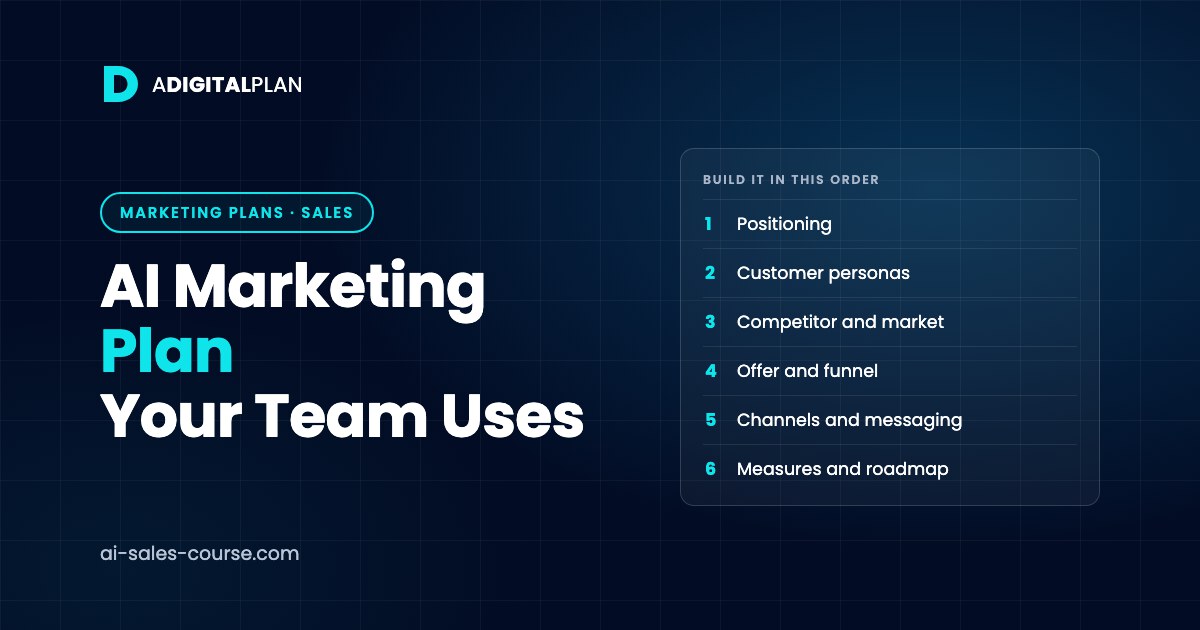
How to build an AI marketing plan in order
Each step feeds the next. Don’t skip ahead; the later sections only work if the early ones are specific.
- Positioning. One paragraph: who you serve, the problem you solve, and why you rather than the alternatives. Ask Claude to challenge it until it is specific.
- Customer personas. Two or three, built from real customer words such as reviews, emails and call notes, not imagined ones.
- Competitor and market view. What buyers can choose instead, and where your offer is clearly different. Use public information only.
- Offer and funnel. How a stranger becomes a customer: the first step, the follow-up and the offer.
- Channels. Pick the two or three where your personas already spend time. Write why each was chosen and what it is for.
- Messaging. The core message and three supporting points, in your customers’ words.
- Content, email and paid plans. What each channel publishes, how often, and how it hands people on to the next step.
- Measures. One or two numbers per channel that show whether it is doing its job.
- Roadmap. The next ninety days as weekly actions with an owner for each.
Working through a structured digital marketing strategy template like this one stops the blank-page problem. Here is the first prompt:
I run [business] serving [who].
Here is what customers say about us: [paste reviews, emails or notes].
Here are the main alternatives buyers consider: [list].
Draft a one-paragraph positioning statement: who we serve, the problem
we solve and why we are different. Then list three ways it is still
too vague, and ask me the questions that would fix them.
And the prompt that turns the plan into actions:
Here is our marketing plan so far: [paste sections 1 to 8].
Turn it into a 90-day roadmap of weekly actions. Each action has one
owner from this list: [names or roles]. Keep it to what a team of
[size] can really do. Flag anything that depends on budget we have not agreed.
Worked example (fictional demo)
The business below is a fictional demo, made up to show the method.
Copperfield Bikes is a small bike repair and sales shop with a website, an Instagram account and an email list it rarely used. The owner and two staff built the plan in order. Customer reviews showed their best buyers were commuters who needed their bike fixed fast. That became the positioning: same-week repairs for people who ride to work. The channels became local search, Instagram and a monthly email with a maintenance tip. The roadmap had one action per person per week, and the whole plan fitted on four pages. When a new idea came up, the team asked one question: does it serve the commuter?
If social media is one of your main channels, our guide to a social media marketing strategy shows how that part of the plan becomes a sales funnel.
Common mistakes
- Starting with channels before positioning.
- Writing personas from imagination.
- Planning more channels than the team can run.
- Letting AI invent competitor facts or market figures. Check everything against a source.
- Writing the plan alone and handing it over. Teams use plans they helped make.
Build the full strategy
The AI Marketing Strategy Operating System is our AI marketing course for building this from scratch. It runs in three parts: strategic foundations and market intelligence, strategy assets and campaign planning, then automation, execution and putting the strategy together. Each lesson has its own AI prompts. You finish with one connected strategy document covering positioning, personas, competitors, funnel, messaging, content and SEO, paid ads, email, conversion, measurement, budget and growth planning, and an execution roadmap.
FAQ
How long should an AI marketing plan be?
Short enough that the team opens it every week. Many small businesses can fit the essentials on a few pages, with detail kept in separate working documents.
Can AI write the whole plan for me?
It can draft every section. It can’t know your customers, your capacity or your budget unless you tell it, and the decisions have to be yours.
How often should we update it?
Review the roadmap every week and the whole plan every quarter, or sooner if your offer or market changes.